


TEC Science Class | What are Thermoelectric Particles? What Key Role Do They Play in the Cooling Chip?
Welcome to the TEC Science Popularization Classroom! The thermoelectric particles in the thermoelectric cooling chip are simply called DICE. It is not only a key component of TEC but also determines its core performance. This article will focus on the role and design points of the thermoelectric particles (DICE). If you have any questions about the content of the article or want to learn more about TEC, please leave a message in the comment section~
I. The Role of Thermoelectric Particles in TEC
The main material of thermoelectric particles is Bi₂Te₃ (tearod铋). Depending on the doping method, they can be classified into two types: P-type and N-type. P-type and N-type thermoelectric particles must be used in pairs to form a basic thermoelectric unit - usually called a thermocouple. The smallest working unit of TEC is precisely composed of such a pair of P-type and N-type particles connected in series through metal electrodes (i.e., sintering points), with one end forming the cold end of TEC and the other end forming the hot end.
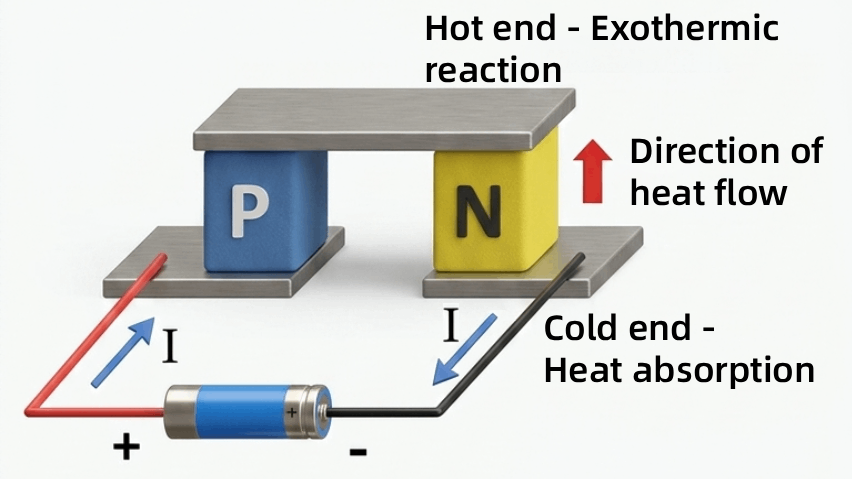
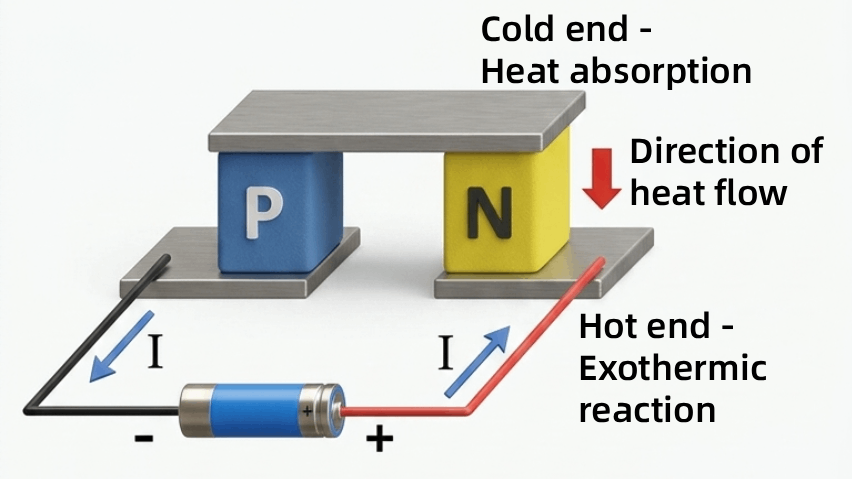 Under the influence of an external electric field, the current will drive the heat to migrate directionally from one end to the other, forming a clear cold end and a hot end. When the current direction reverses, the cold and hot ends will also swap. This is the core principle by which TEC can achieve both cooling and heating functions in both directions, and it fully demonstrates the crucial role of thermoelectric particles in TEC.
It should be noted that the above description is based on a single thermocouple. However, the cooling capacity of a single pair of thermocouples is limited and cannot meet the requirements of practical applications. Therefore, commercial TECs are usually composed of dozens or even hundreds of thermocouples integrated and combined.
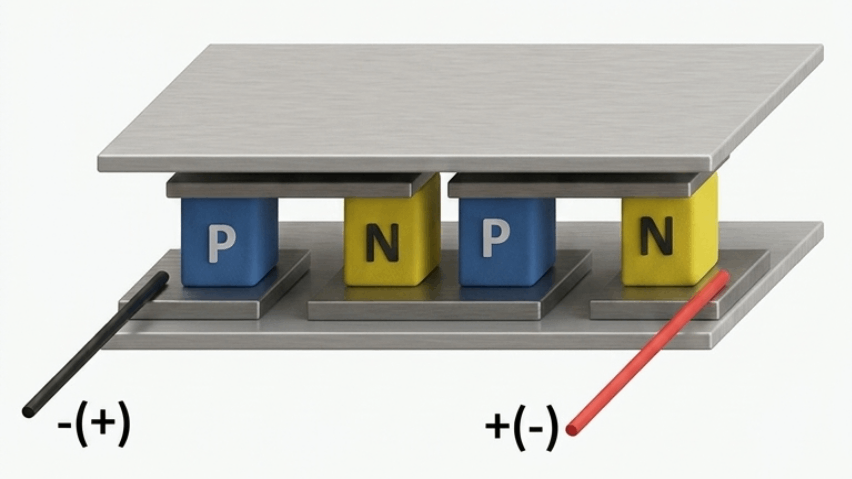
Due to the fact that rectangular particles are prone to size deviations during processing and assembly, resulting in reduced yield, most thermoelectric particles adopt a square design. Although a few manufacturers do use cylindrical particle designs, this design requires higher requirements for crystal rod preparation and cutting processes, and thus is less commonly used in practical applications. In terms of circuit connection methods, thermoelectric particles typically use a series connection form. Although a parallel connection form is theoretically possible, due to the potential uneven current distribution or thermal interference between the particles, it is prone to cause local overheating or performance imbalance. Therefore, series connection remains the current mainstream solution.
II. DICE Key Parameter Design
To fully utilize the performance of TEC, the geometric size and electrical parameters of the thermoelectric particles need to be precisely designed. Here are several key calculation formulas:
☑️ DICE Size Calculation
The calculation formula for the DICE size to achieve the maximum current Imax is: A=(Imax × L) /K
A: DICE cross-sectional area (mm²)
L: DICE height (mm)
K: Thermal conductivity of the material, which is only related to the thermoelectric material itself and temperature, and does not change with the maximum current; at a given temperature, the value of K can be determined or calculated.
Since the cross-section of a conventional DICE is a square, the above formula can be simplified as: W²=(Imax × L) /K
W: Cross-sectional width (mm)
☑️ DICE size ratio
Under the condition of the same maximum current, the ratio of the cross-sectional area to the height of the DICE remains constant, and the specific relationship is as follows: A/L=A₁/L₁
A₁: New DICE cross-sectional area mm²
L₁: New DICE height mm
This proportional relationship provides a theoretical basis for the scaling design of DICE.
☑️ Calculation of DICE resistance
After determining the size, the DICE resistance value can be calculated using the following formula:
R = (ρ x L) / A
R: DICE resistance value mΩ
ρ: DICE resistivity mΩ·cm
The above parameters jointly determine the working voltage, power consumption and cooling efficiency of the thermoelectric cooling sheet, and are the key basis for the design of TEC products.
In conclusion, thermoelectric particles are the core component of TEC. The material type, the pairing method of P-type and N-type, the geometric size, and the resistance and other parameters directly determine the cooling performance, working stability and application range of TEC. As a leading global supplier of thermoelectric cooling devices, FerroTec leads thermoelectric offers a variety of high-performance thermoelectric cooling chips, with power, materials and appearance all customizable. If you need to know more about the products or obtain solutions, please feel free to contact us: 13575452327.