


Solid-state drives overheat and slow down? Thermoelectric cooling is becoming a new solution for temperature control!
With the widespread adoption of PCIe 5.0 solid-state drives (SSDs), sequential read and write speeds have generally exceeded 10GB/s. However, the power consumption and heat generation of the main control chip have also significantly increased. In scenarios of high capacity and continuous heavy write loads, if the temperature of the high-end SSD main controller is too high, it will trigger overheating and slow down, resulting in a significant decline in performance. Traditional passive cooling solutions - such as aluminum heat sinks or miniature fans - have struggled to cope with such high heat flux densities. To solve this problem, thermoelectric cooling (TEC) technology has begun to enter the SSD cooling field, providing an active and precise temperature control new idea for high-performance storage.
I. Application of TEC Technology in Solid-State Drives
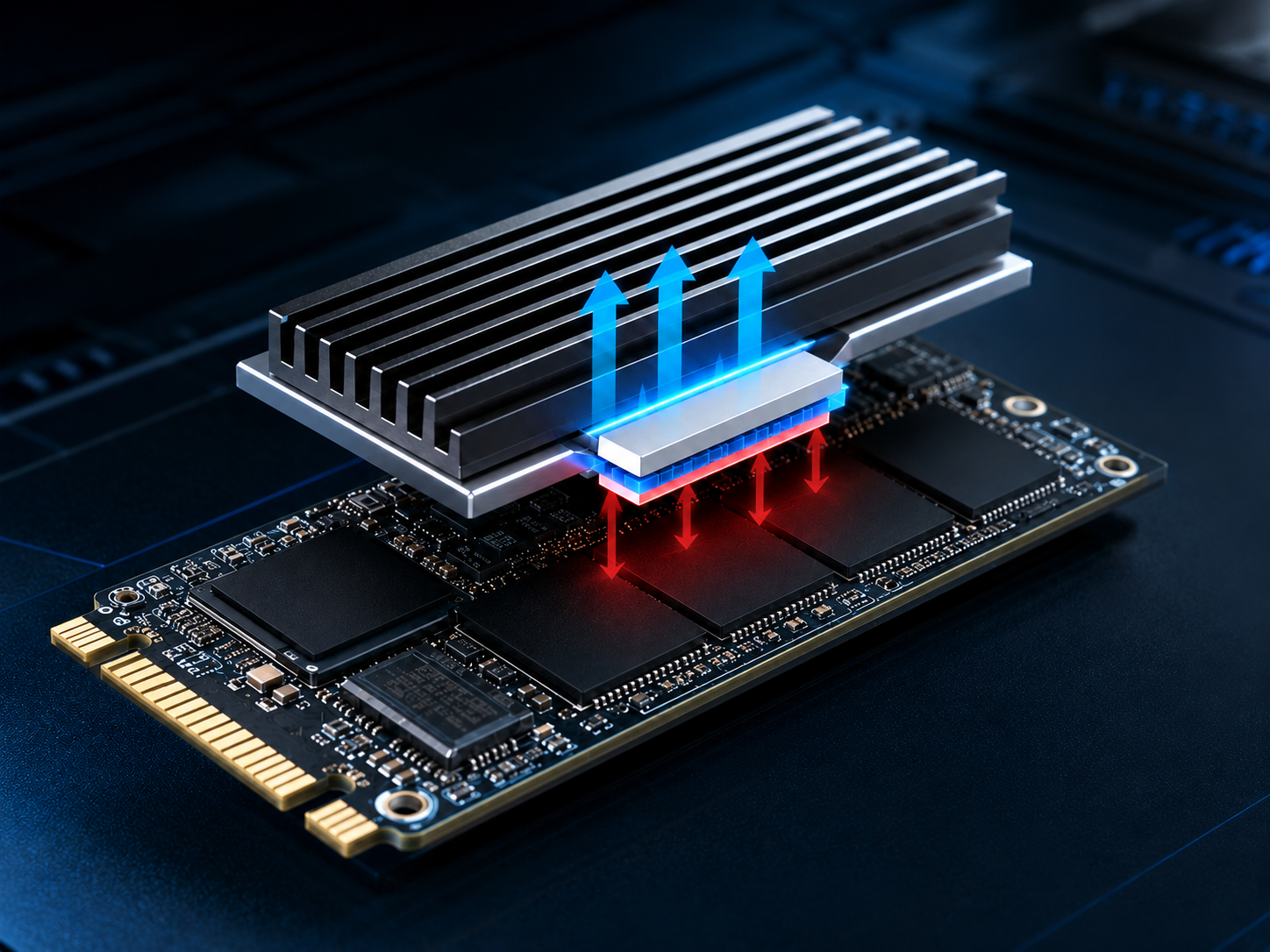
The operation of thermoelectric cooling chips is based on the Peltier effect: when direct current passes through an electrically conductive pair of P-type and N-type semiconductors, one end absorbs heat to form a cold end, and the other end releases heat to form a hot end, achieving the active and directional transportation of heat. Its greatest advantage lies in - allowing the cooled object to have a temperature lower than the ambient temperature, thus eliminating the dependence on the temperature difference of the environment for passive heat dissipation.
Modern SSD main control chips use advanced manufacturing processes, with an area often less than 10mm², but the heat flux density can reach several watts per square centimeter. In high-temperature environments (such as above 40℃), passive heat dissipation can have an extremely small temperature difference, which is prone to triggering frequency reduction and affecting the stability of the chip. However, thermoelectric cooling chips can actively cool, ensuring that SSDs can still maintain full-speed operation under high load and high-temperature conditions, providing a reliable temperature control guarantee for the ultimate storage experience.
II. Limitations of TEC Technology Application
Integrating thermoelectric cooling chips into compact SSDs such as M.2 still faces two major technical challenges:
1. Condensation Risk
When the cold end temperature of the cooling chip is lower than the dew point of the ambient air, water vapor may condense on the circuit board, causing short circuits or corrosion. Although the humidity in daily usage environments is relatively low, the risk is manageable. However, in high-humidity scenarios, protective measures must still be taken - common practices include coating the cooling chip and surrounding circuits with hydrophobic or insulating coatings (such as anti-wear paint), forming a dense protective layer to effectively isolate moisture.
2. Heat End Cooling and System Integration
While transporting the main control heat, the cooling chip itself will also generate additional heat loads due to Joule heating. Therefore, a complete cooling module must include cold-end heat conductive pads, TEC chips, heat-end fins, and even micro fans - this poses very high requirements for structural layout and air duct design. Fortunately, the peak power consumption of typical SSD controllers under high load can reach 5-10W, and the driving power of the TEC is only 3-5W, so the overall thermal management burden remains within an acceptable range and is feasible for engineering implementation.
In summary, thermoelectric cooling technology is providing a new active temperature control solution for high-end SSDs in high-load scenarios such as data centers and workstations, and is expected to be a key technology to break through the bottleneck of high-speed storage cooling in the next generation.