


In space scenarios, how does the thermoelectric cooling module achieve stable cooling?
When using thermoelectric cooling chips (TECs) on the ground, people rarely worry about the heat dissipation issue - after being powered on, the cold end of the cooling chip cools down, and the hot end dissipates heat through convection with the air, along with fans or heat sinks, to ensure stable operation. However, once in space, the situation changes. In a vacuum environment, there is no air, and thus no convection. The heat at the hot end of the cooling chip cannot be discharged, and the cooling performance will sharply decline. So, how does the TEC cooling chip achieve effective cooling in a vacuum? Let's take a look.
I. Spaceflight Scenario: TEC Heat Dissipation Challenge
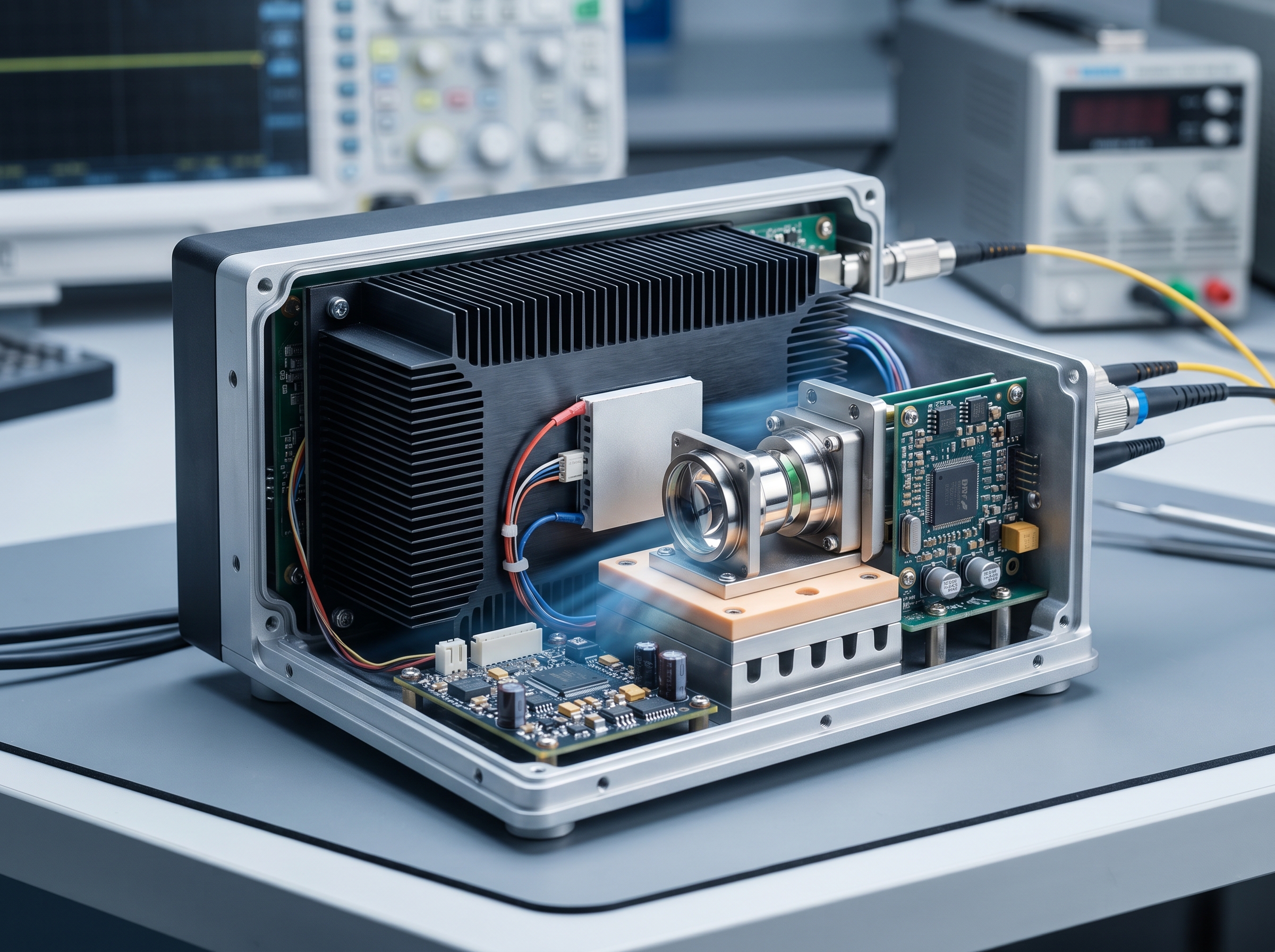
The working principle of TEC is based on the Peltier effect. It does not generate coldness itself; instead, it cools by transporting heat - the cold end absorbs heat to lower its temperature, while the hot end releases heat to increase its temperature. In the terrestrial environment, the heat dissipation capacity of heat sinks combined with fans can reach several hundred to several thousand milliwatts per square centimeter. However, in space or high vacuum environments, convective heat dissipation completely fails, and the only two reliable heat dissipation methods are thermal conduction and thermal radiation. Among them, the efficiency of thermal radiation is extremely low. At room temperature, even on a blackened surface, the heat radiation dissipation power is only 5 to 10 milliwatts per square centimeter. Relying solely on radiation, the temperature at the hot end will continue to rise, eventually causing the cold end to be unable to cool down, and the TEC to lose its cooling capability.
II. TEC Heat Dissipation Solution
To enable TEC to function properly in a vacuum, the first step is to address the heat dissipation issue at its thermal end:
☑️ Enhance heat radiation capacity
According to the Stefan-Boltzmann law for heat radiation power: P = ε·σ·A·(T⁴ - T₀⁴), there are two ways to improve the radiation efficiency:
1. Increase the emissivity ε: The emissivity of polished metal surfaces is only 0.05 to 0.2, but it can approach 1 after anodic oxidation or blackening treatment;
2. Increase the radiation area A: Satellites often lay heat dissipation plates over a large area of the outer shell to maximize the radiation heat dissipation surface.
☑️ Build an efficient heat conduction channel
TEC is only a few millimeters thick and cannot directly contact the external heat dissipation plate. It needs to transfer heat through an intermediate medium:
1. Heat-conducting cords: Composed of multiple layers of copper braided strips or graphite films, they have good flexibility and can be bent to adapt to the complex layout inside the satellite.
2. Heat pipes: The internal working fluid undergoes an evaporation-condensation cycle for heat transfer, with an equivalent thermal conductivity up to hundreds of times that of copper, capable of quickly transporting heat to the distant heat dissipation surface.
The heat-conducting cords are responsible for drawing heat from the TEC's thermal end, while the heat pipes are responsible for quickly transporting heat to the heat dissipation plate. The combination of these two can effectively solve the heat dissipation path problem in a vacuum environment.
III. Aerospace Scenario: Advantages of TEC Application
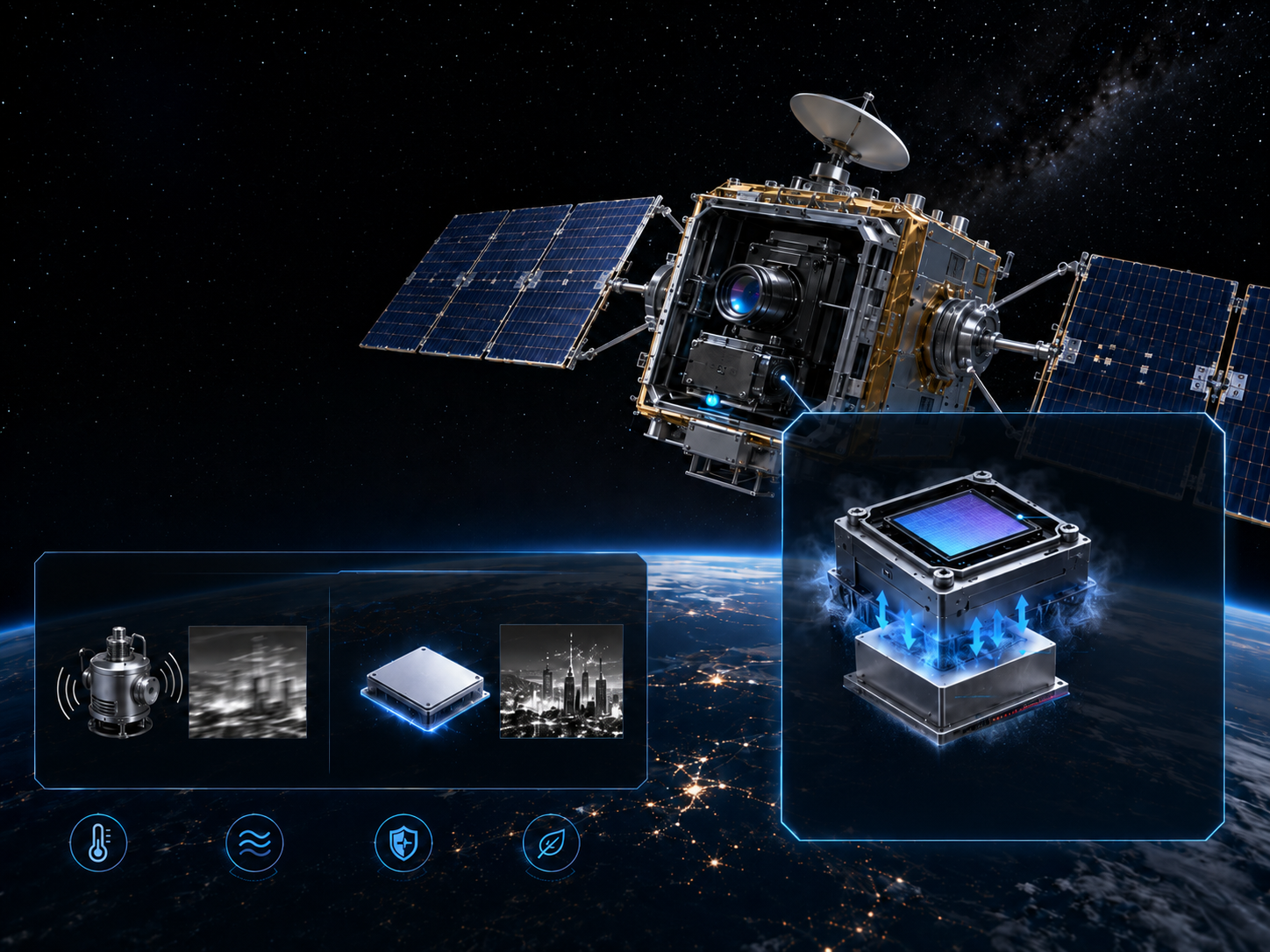
After addressing the heat dissipation issue, with its unique advantages such as no vibration, no moving parts, and precise temperature control, TEC has achieved indispensable temperature control applications in the aerospace field:
1. No vibration: The detectors of infrared remote sensing satellites need to operate stably below -40℃. Mechanical refrigeration units generate micro-vibrations, which interfere with imaging quality; while TEC operates silently without vibration, making it an ideal choice for high-precision optical payloads.
2. High-precision temperature control: Laser communication terminals are extremely sensitive to wavelengths. TEC can achieve milliwatt-level heat pump regulation, stabilizing temperature fluctuations within ±0.01℃, ensuring communication coherence.
3. Compact and lightweight: Extravehicular spacesuits need to maintain a comfortable temperature of 18-25℃ locally. Traditional liquid cooling suits rely on pumps, water pipes, and coolant, which have a complex structure; TEC can be directly embedded in the inner layer of the spacesuit, with a lightweight system and no need for external pumping or coolant support.
It is precisely through the collaborative design of enhanced radiation heat dissipation and efficient heat conduction pathways that TEC can operate stably in a vacuum environment. As deep space exploration continues to deepen, the application of TEC in space will become increasingly widespread, gradually becoming a reliable temperature control option for deep space missions.