


TEC Science Class | Lightning Protection Application Guide: Testing, Installation, Power Supply... None Can Be Missed!
In the actual application of TEC (thermoelectric cooling sheet), we often receive questions from customers:
"After installing the cooling device, why is the temperature difference so small?"
"The measured resistance doesn't match the specifications. Could it be that there is something wrong with the product?"
After extensive project support and on-site analysis by the FerroTec lead thermoelectric technology team, it was discovered that - the vast majority of these problems do not stem from the quality defects of the TEC itself, but rather from deviations in the testing methods or installation procedures. This article will, based on common cases, systematically clarify the typical misunderstandings of clients in TEC testing, helping everyone to assess product performance more scientifically and accurately.
I. Common Causes of TEC Resistance Deviation
Many customers are accustomed to using ordinary multimeters to measure the TEC resistance during the incoming material inspection or testing stage, and compare the measurement results with the standard values specified in the specification sheet. Once a deviation is detected, they will question the product consistency. In fact, this difference is caused by the improper selection of the testing tool:
①The TEC resistors are usually very small (in the milliohm range) - if you measure the resistance using a common multimeter (with two-wire measurement), the resistance of the test leads and the contact points will be included in the measurement, resulting in significant measurement errors;
②TEC is a temperature-sensitive resistive component - for every 10℃ change in ambient temperature, the resistance may drift by 3% to 5%. Therefore, if the test temperature is inconsistent with the calibration conditions specified in the specification (usually 25℃), the results will naturally deviate.
Therefore, the resistance measured using a regular multimeter only has reference value and cannot be used as a definitive criterion. If an accurate assessment of the TEC resistance is required, it is recommended to use a four-wire milliohm meter or an LCR bridge and other precision instruments. The test should be conducted under standard temperature control conditions to obtain reliable and comparable performance data.
II. Common Causes of TEC Temperature Deviation
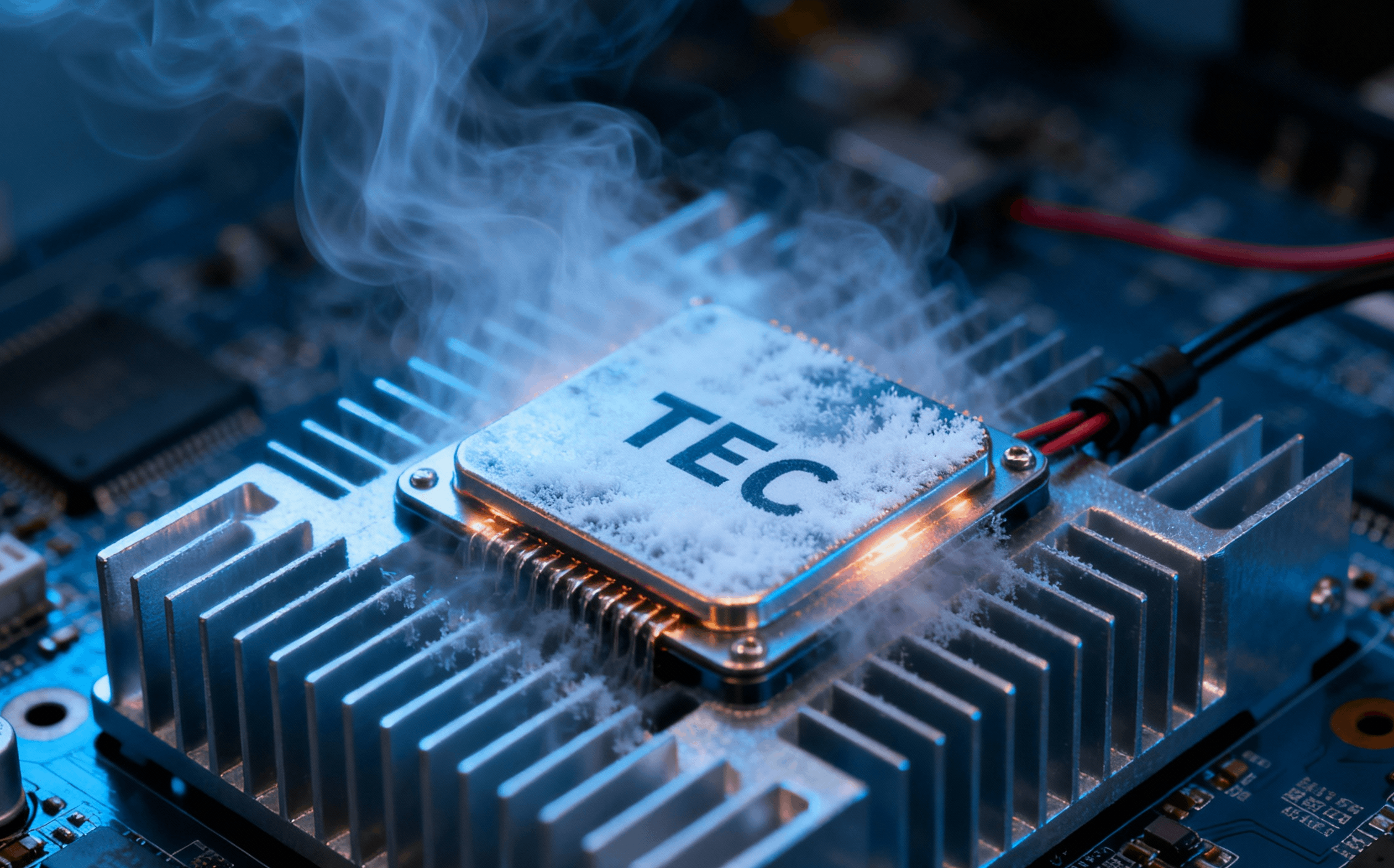
During the testing of the complete machine or prototype, the most frequently reported problem by the customers is: "After the TEC is powered on, the temperature difference between the cold and hot surfaces is not obvious." The actual reason for this issue is either an unreasonable system design or inadequate installation process.
①Ignore the "thermal short circuit" problem
"Thermal short circuit" is a very subtle yet significant problem in TEC applications - that is, an unintended low thermal resistance path forms between the cold end and the hot end, causing heat to bypass the TEC and flow back directly, significantly reducing the cooling effect. Common causes include:
☑️ There is a lack of an effective insulation structure between the hot and cold ends.
☑️ Metal supports, screws or casings directly connect the cold and hot sides.
☑️ Excessive thermal conductive paste was applied. After installation, it overflowed from the cold surface and came into contact with the hot end.
Because the thermal conductivity of the silicone grease is relatively high, once a conductive path between the cold and hot ends is formed, the temperature of the cold and hot surfaces will be quickly "evened out", resulting in a significant reduction in the temperature difference between the local area and the overall area.
②Excessive thermal resistance during contact
The performance of TEC is highly dependent on good thermal contact, but this aspect is often underestimated in practical applications. If not installed properly, it is very likely that the cooling efficiency will drop significantly due to excessively high contact thermal resistance. Common problems include:
☑️ The flatness or parallelism of the mating parts (such as cold plates, heat sinks) is insufficient;
☑️ Excessive roughness on the surface;
☑️ The installation surface has warping and local point contact;
☑️ The thermal paste is not evenly applied, and there are even air bubbles or voids remaining.
These issues will lead to:
The actual contact area between TEC and the cooled object is much smaller than the theoretical value.
➡️ The thermal resistance of contact has significantly increased;
➡️ The cooling capacity cannot be effectively transferred, resulting in a significant reduction in the cooling effect.
It is particularly important to note that the amount of thermal conductive paste is not necessarily the more the better. Excessive application may cause the paste to overflow and result in a thermal short circuit. It is recommended to apply the paste evenly and thinly according to the specification guide, keeping the thickness at approximately 0.05mm (or 5 mils), so as to achieve the best thermal conduction effect.
③Inappropriate power supply method
In TEC applications, there is another typical cognitive error: "The greater the electrical power, the better the cooling effect." In fact, this view is not correct. If the power is blindly increased when the heat dissipation capacity is insufficient, the following problems will arise:
☑️ The temperature at the hot end rose sharply, leading to an intensification of reverse heat conduction;
☑️ The actual temperature difference ΔT has decreased instead of increasing, resulting in a decline in the cooling effect.
☑️ The energy efficiency ratio (COP) has sharply declined, leading to a "high consumption and low efficiency" predicament.
Many customers noticed that the current increased, but the TEC heat generation became significantly higher, while the cold end temperature did not decrease but actually rose. This is not usually due to a quality issue with the TEC itself, but rather the system is not operating at a reasonable working point - that is, the current, voltage and heat dissipation capacity have not achieved the optimal match. To find the best working point, please contact us. We will provide you with debugging suggestions and optimization solutions that match your actual needs.
TEC is not a plug-and-play standard component, but rather a highly-coupled system engineering involving heat, electricity and structure. Only through scientific testing, standardized installation and matching heat dissipation design can its performance potential be fully unleashed. If you encounter problems such as insufficient temperature difference or low cooling efficiency in practical applications, it is recommended to prioritize checking the aforementioned common misunderstandings. For further support, please contact the FerroTec leading thermoelectric technology team. We will provide you with more professional services.