


Why does laser marking always "go wrong"? The truth is that the temperature is not controlled properly!
The principle of laser marking is: using a precise beam to carve fine text and patterns on the surface of metals, plastics or glass. The laser beam is extremely sensitive to temperature - even a tiny fluctuation can lead to a significant reduction in the marking effect: the lines become thicker, the depth is uneven, and in severe cases, it can even cause the product to be scrapped. To solve this problem, some high-end laser marking equipment integrates a thermoelectric cooling sheet in the laser source to ensure that the laser source operates stably within the optimal working temperature range, achieving clear, consistent and reliable marking effects.
I.Why is the laser marking machine particularly sensitive to temperature changes?
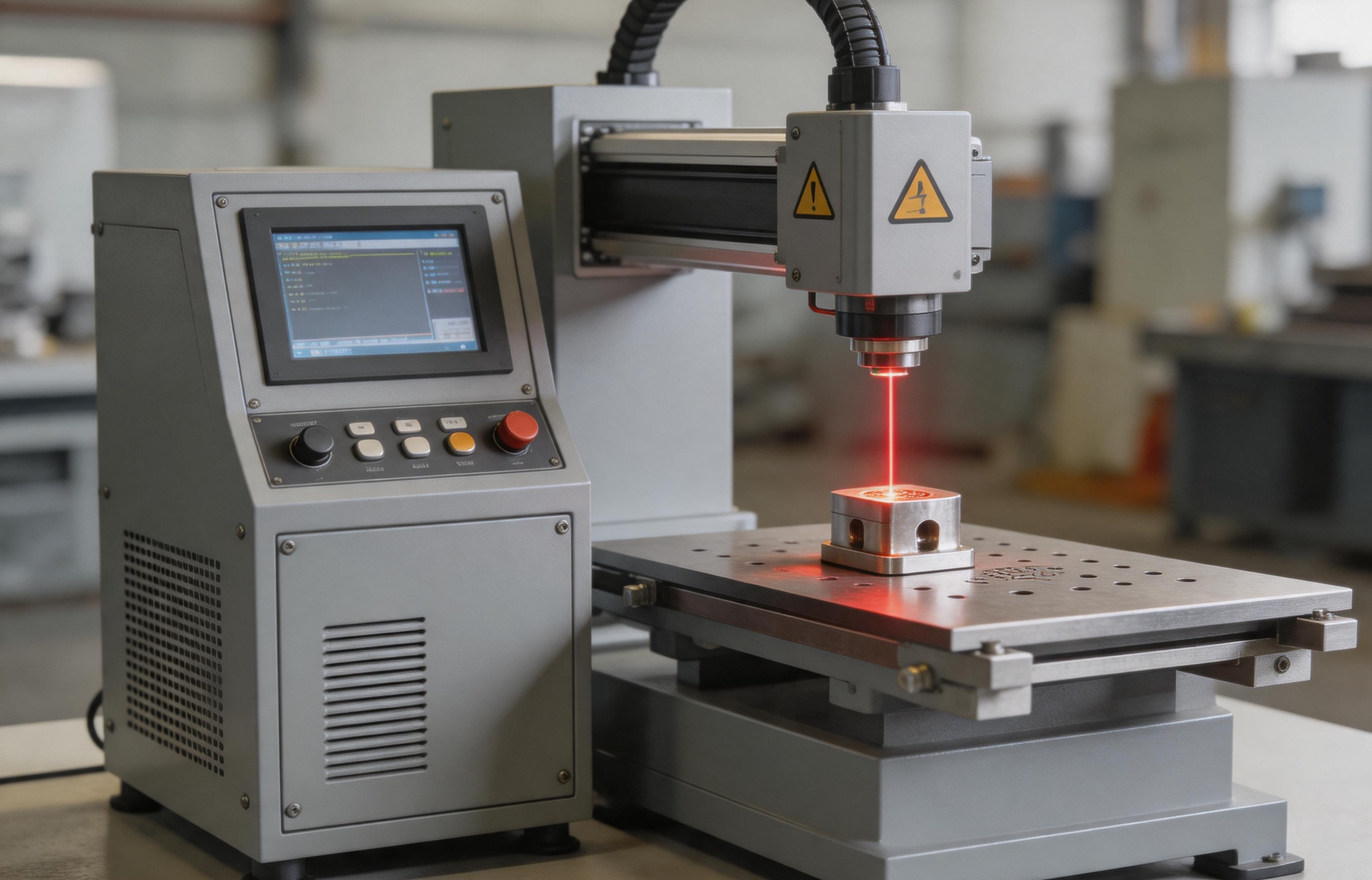
During the operation of the laser marking machine, some electrical energy is released in the form of heat. If this heat cannot be dissipated in time, two major problems will arise:
1.Power reduction
If the temperature of the laser is too high, it will reduce the efficiency of photoelectric conversion, resulting in a decrease in output power and making the originally clear marking traces become fainter.
2. Wavelength drift
Once the temperature fluctuates, the laser wavelength will also drift, causing the light to focus inaccurately and directly affecting the clarity and shape of the marking pattern - it could be blurry or even distorted.
From this, it can be seen that lasers are afraid of both high temperatures and temperature fluctuations - only by achieving precise temperature control can the impact of temperature on the laser be reduced, ensuring the stability of the laser marking quality.
II. Why do traditional temperature control methods not work well?
In the face of thermal management challenges, some laser equipment adopts water cooling for temperature control, using circulating water to remove the heat generated by the laser. This method seems simple and effective, but there is an unavoidable problem: the water temperature will slowly drift over time or with environmental temperature, making it difficult to maintain long-term stability. The fluctuations will then be transmitted to the laser, interfering with the optical path system.
For ordinary processing scenarios, slight fluctuations generally do not affect the final result. However, in precision marking scenarios - such as engraving QR codes on chips or marking medical devices - even a 0.1℃ temperature deviation can directly lead to product scrapping. This is why most manufacturers do not use traditional temperature control methods.
III. Application of thermoelectric cooling in laser printing
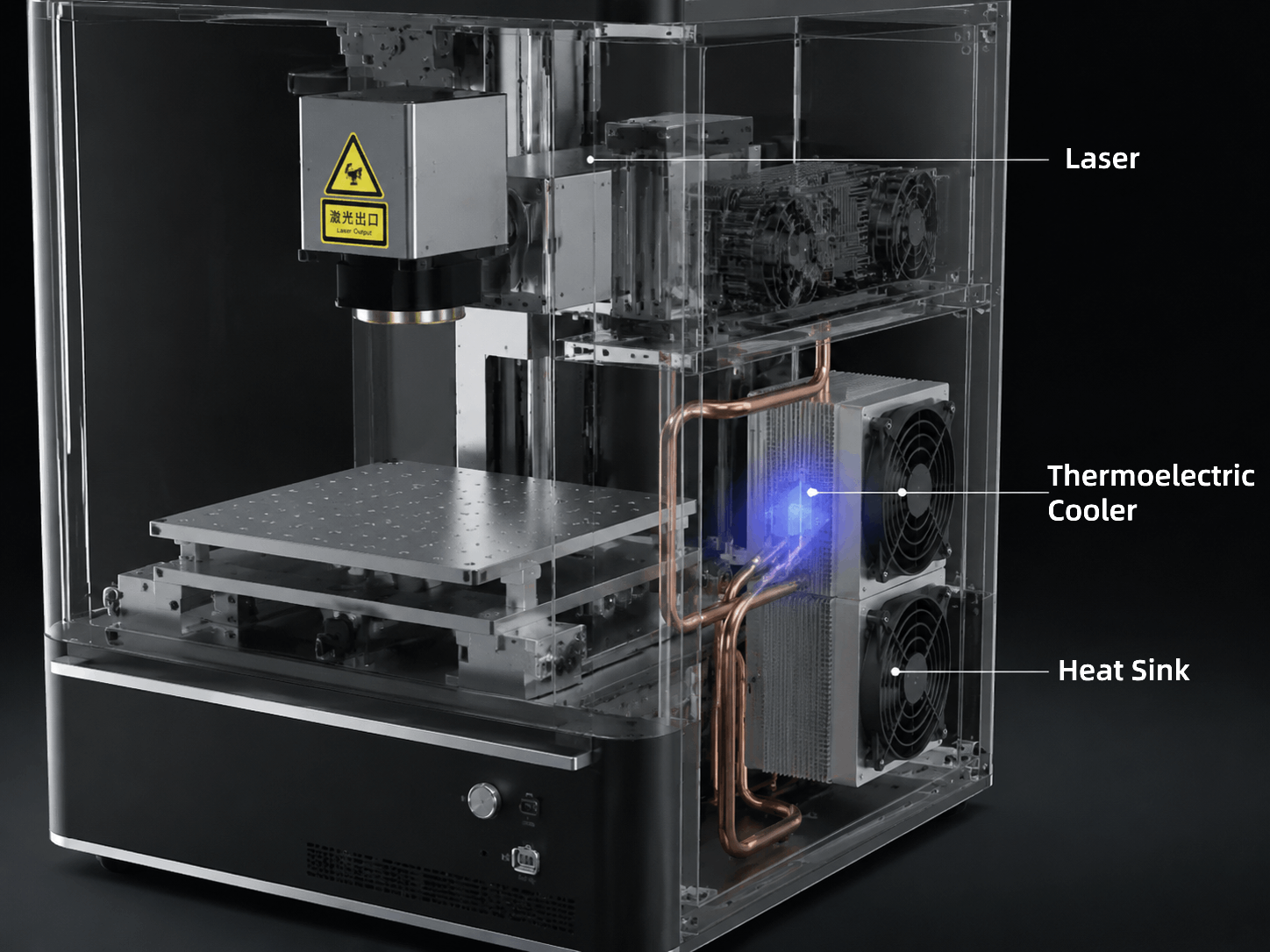
So, is there a solution that can respond quickly while maintaining precise temperature control? The answer is: the thermoelectric cooling (TEC) solution. You can think of the cooling chip as an electronic pump that can "transport" heat in a targeted manner. In practical applications, the TEC module is usually integrated between the laser and the heat dissipation system:
The cold surface is close to the laser, absorbing the heat generated by the laser;
The hot surface is close to the heat sink and fan, discharging the heat to the outside air;
An internal temperature sensor is placed in the middle to monitor the laser temperature in real time and feed it back to the control system.
When the temperature is high, the system will automatically increase the current to make the cooling chip remove more heat; when the temperature is low, the system will reduce the current to lower the cooling intensity. Through dynamic adjustment, the laser temperature is stabilized within the ±0.01℃ range of the set value - the temperature control accuracy is several to hundreds of times higher than that of traditional water cooling, meeting the precise temperature control requirements for precision marking.
IV. Advantages and Disadvantages of the Thermoelectric Cooling Solution
☑️Advantages:
1. More accurate marking: The line edges are straight and sharp, without any frayed edges or blurriness, and the detail reproduction is high;
2. Consistent effect: Regardless of changes in ambient temperature, the marking depth and color of the same pattern remain consistent;
3. More durable machine: The laser operates in a constant temperature state for a long time, away from high temperatures and thermal shocks, significantly extending its service life.
❎️Weaknesses:
1. Not necessarily more energy-efficient: The energy efficiency of TEC is limited - transporting one unit of heat usually requires two or more times more electrical energy. For high-power lasers, traditional water cooling still has advantages in energy consumption and cost.
2. Dependent on heat dissipation capacity: TEC only "moves" heat from the laser to the heat sink, and ultimately, it still relies on the heat sink and fan to discharge the heat. If the rear-end heat dissipation (such as heat sink + fan) design is insufficient, the heat cannot be discharged in time, and instead, it will cause temperature accumulation, which is counterproductive.
3. Beware of condensation risk: When TEC cools the laser to a temperature lower than the ambient dew point, water vapor in the air will condense on the device surface, causing short circuits or optical pollution. Therefore, in high-humidity environments, it is necessary to combine sealing, moisture-proofing or temperature control strategies to avoid condensation.
Thus, TEC technology is currently applicable to: medium power (from tens to two hundred watts), scenarios with extremely high requirements for temperature accuracy, for laser marking.
As a leading global supplier of thermoelectric cooling devices, FerroTec leads in thermoelectric cooling chips, with customizable power, materials and appearance. If you need to know more about the product details/solutions, please contact us: 13575452327.