


When TEC is integrated into the vehicle's air conditioning system, the on-board refrigerator will witness a significant performance improvement!
In recent years, as new energy vehicles have accelerated their transition towards intelligence and high-end features, in-vehicle refrigerators have gradually shifted from being optional high-end accessories to standard features in many vehicle models. Compared with traditional refrigeration mechanisms, thermoelectric cooling (TEC) has emerged as the preferred technology solution for small-capacity in-vehicle refrigerators due to its advantages such as small size, no need for refrigerants, quiet operation, and support for both cooling and heating functions.
I. New Applications of TEC in Vehicle Refrigerators
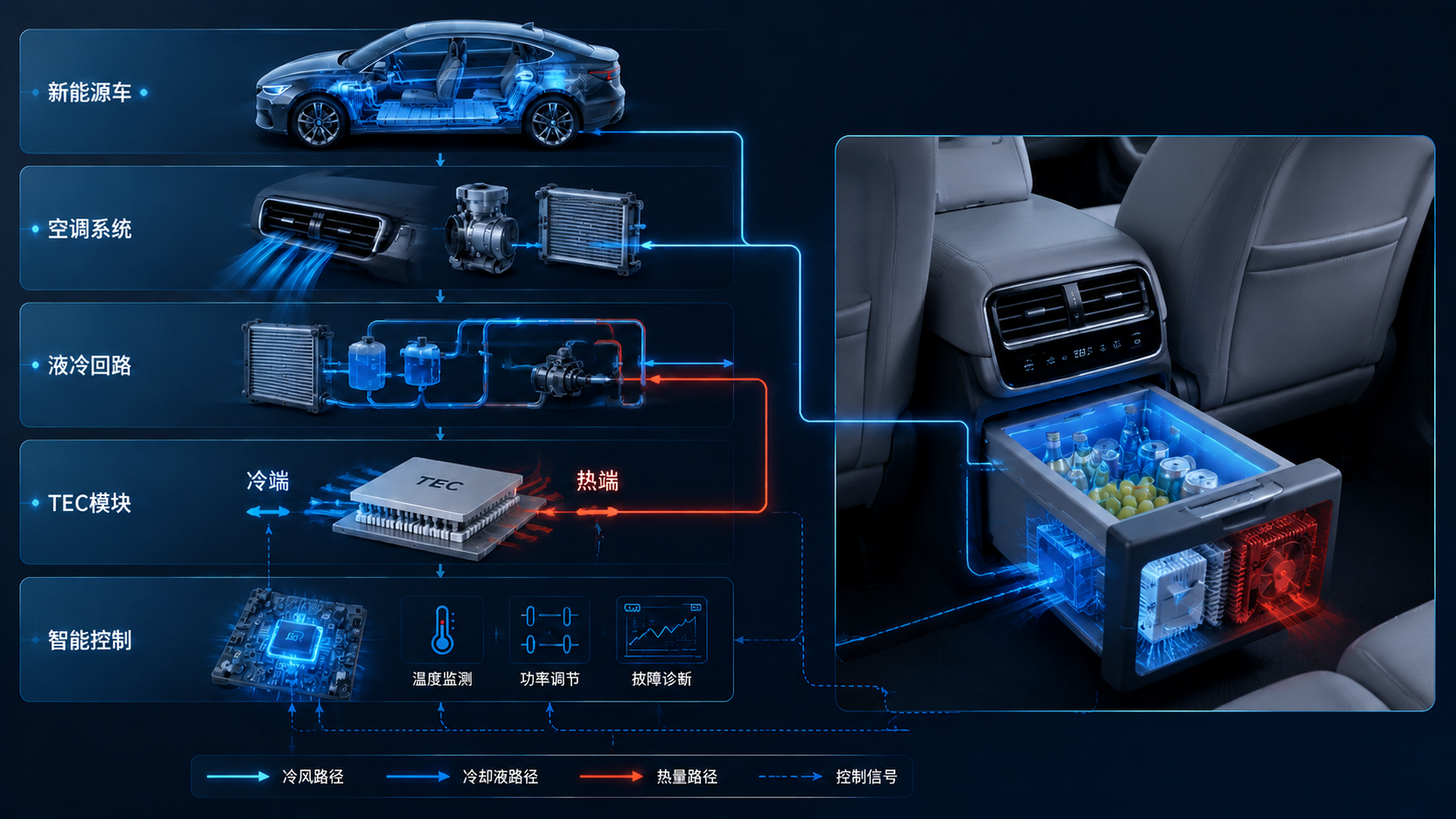
However, as users' requirements for the performance of in-vehicle refrigerators continue to rise, the traditional single-stage TEC solution has gradually failed to meet their needs. For instance, in an environment with a temperature of 35-40°C under intense sunlight, users expect the refrigerator to still cool down quickly and maintain a temperature of 0°C or even lower for a long time - this poses a greater challenge to the single TEC refrigeration system.
Many people mistakenly believe that "increasing the number of TECs can improve performance", but this is not the case. The cooling effect not only depends on the cold end but is more crucially determined by the heat dissipation efficiency of the hot end. If the heat dissipation at the hot end is not timely, the heat transported by the TEC cannot be quickly discharged, and the temperature difference between the cold and hot ends continuously decreases, resulting in a significant decline in cooling capacity and efficiency.
Therefore, the industry is turning to system-level innovation: integrating the TEC hot end with the vehicle's thermal management system instead of using the traditional air cooling method. By leveraging efficient heat dissipation paths such as liquid cooling or air conditioning circuits, the temperature at the hot end can be stably controlled at a lower level, reducing the impact of high temperatures. Currently, the top solutions in the industry have achieved refrigeration temperatures as low as -20°C or even lower, meeting users' greater demands for freezing and preservation.
II. Two Efficient Heat Dissipation Solutions for Vehicle Refrigerators
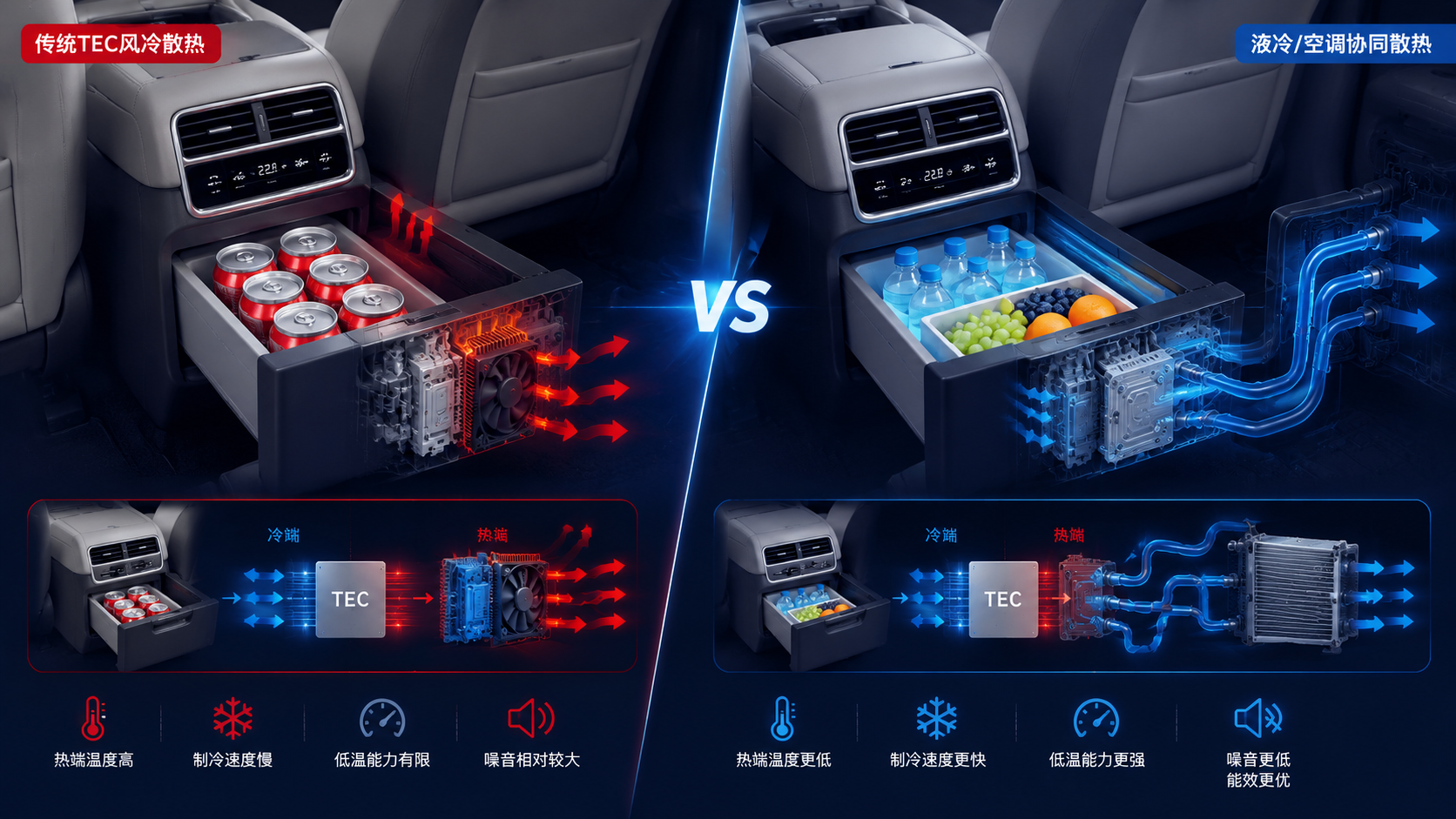
Currently, the mainstream efficient cooling solutions in the industry mainly include two types: ① During the operation of the air conditioner, a portion of the low-temperature air is directed towards the heat-end radiator of the TEC for auxiliary cooling; ② The heat-end of the TEC is directly integrated into the vehicle's liquid cooling circuit, and heat is continuously removed through the cooling plate and coolant. When the temperature at the heat end significantly decreases, the TEC system can achieve multiple performance improvements:
✅ Faster cooling speed - the cold end quickly reaches the target temperature;
✅ Further reduction in the lowest temperature range - easily achieve stable refrigeration below 0℃ or even -20℃;
✅ Simultaneous optimization of energy efficiency and noise reduction - no need for long-term full-power operation, and the overall power consumption and noise level are significantly reduced.
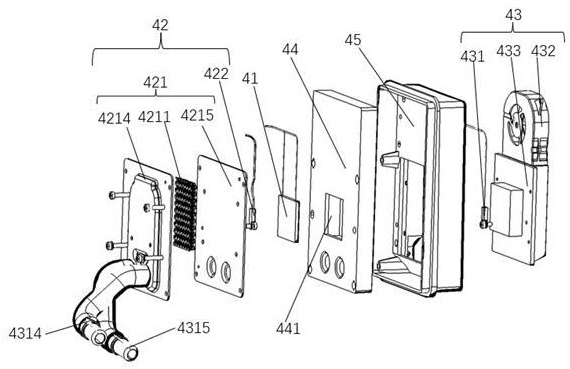
Compared with the single compressor or single refrigeration chip refrigerator solutions, the linked TEC refrigerator has advantages such as lower temperature, faster cooling, and lower noise. It is currently becoming a new technical direction for high-end vehicle refrigerators.
Of course, such collaborative solutions cannot simply be achieved by adding an extra cold plate. How can they be efficiently matched with the entire vehicle's air conditioning system? How can condensate water be prevented from entering and electrical safety be guaranteed? How can the comfort of the passenger cabin be maintained while also meeting the cooling requirements of the refrigerator? And how can intelligent and stable control strategies be formulated in different environments and operating conditions? All these questions require in-depth system-level collaborative design between the OEM and core suppliers. FerroTec's leading thermoelectric technology possesses a mature development system and solid engineering capabilities. It can closely cooperate with the OEM and suppliers around the vehicle refrigerator project and provide practical and feasible TEC temperature control solutions.
In the future, the competitive focus of in-vehicle refrigerators will gradually shift from the performance of a single TEC component to the thermal management capabilities of the entire system. The collaborative optimization among TEC, air conditioning compressors, liquid cooling circuits, and intelligent control algorithms will become an important direction for enhancing user experience. With the continuous upgrading of the thermal management architecture of new energy vehicles, the integration of TEC with the vehicle's air conditioning system is expected to become a key technical route for high-end in-vehicle refrigerators.