


The Temperature Control Expert Behind Wireless Communication: TEC Thermoelectric Cooling Technology
The RF module (Radio Frequency Module) is the core component responsible for "transmitting and receiving signals" in wireless communication systems, and it acts as the "translator" between the equipment and the wireless world: the equipment processes digital signals internally, while the air transmission is high-frequency electromagnetic waves. The RF module is responsible for converting between the two.
However, the RF module has a troublesome problem - it hates heat. When it gets hot, the transmission power drops, the reception noise increases, and the transmission frequency "deviates". Mildly, it leads to an increase in bit error rate, and severely, it makes it impossible to receive the signal at all. High temperatures also accelerate the aging of the components. For every 10℃ increase in temperature, the component lifespan is directly halved. Therefore, precise temperature control for the RF module is not an add-on feature, but a necessity. Currently, the industry is attempting to solve this temperature control problem using thermoelectric cooling technology.
I. Advantages of TEC in RF Modules
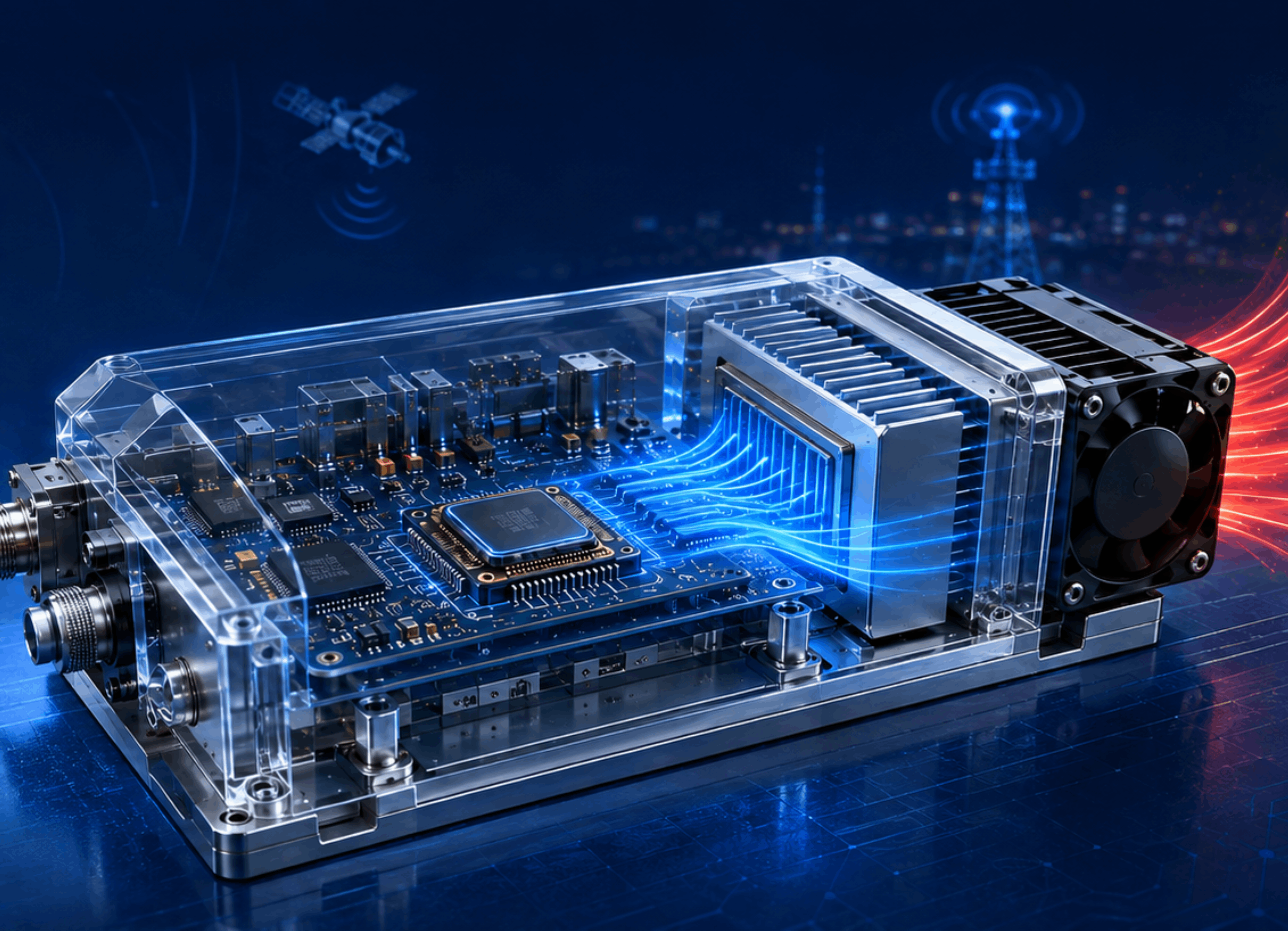
TEC stands for Thermoelectric Cooling Chip. It achieves temperature control based on the Peltier effect: when powered on, heat is transferred from the cold end to the hot end, and the hot end then expels the heat through a heat sink and fan. Without the use of compressors and refrigerant pipelines, it relies solely on the flow of electrons in the thermoelectric material to transport heat. A complete TEC temperature control system typically consists of the following four components working together:
1. Temperature Sensor
Attached closely to the RF chip, it monitors the temperature in real time, with the highest accuracy reaching 0.01℃.
2. Control Chip
It compares the measured temperature with the set target temperature and uses the PID algorithm to make judgments and adjustments: when the measured temperature is too high, it outputs a cooling command; when the measured temperature is too low, it outputs a heating command. The introduction of the PID algorithm enables the temperature to be precisely locked within the target range.
3. TEC Cooling Chip
It receives the cooling or heating command from the control chip, switches the current direction, and performs the corresponding cooling or heating action, pulling the temperature of the RF module back to the target value.
4. Heat Sink
The hot end of the TEC usually requires a heat sink or a small fan to promptly discharge the heat transported from the cold end, ensuring the heat dissipation efficiency of the hot end and maintaining the overall cooling performance.
The entire temperature control system forms a closed-loop operation: when the temperature is high, it cools; when it is low, it heats, continuously fine-tuning, and ultimately stabilizing the temperature of the RF module within a fixed temperature range. However, one thing to note is that frequent switching between cooling and heating will accelerate the aging of TEC. Therefore, during product design, specific control algorithms should be designed based on the specific circumstances to avoid unnecessary cold and hot alternations.
II. Application of TEC in RF Modules

RF modules are widely used in various wireless signal transmission and reception devices, from mobile phones, Wi-Fi routers, Bluetooth headphones, to 5G/6G base stations, phased array radars, satellite communications, and IoT devices - wherever there is wireless signal transmission and reception. And TEC thermoelectric cooling technology has also penetrated into these key scenarios:
☑️ 5G/6G base stations and millimeter-wave equipment: High-frequency communication requires strict frequency stability, and even a small temperature fluctuation can directly affect communication quality.
☑️ Phased array radars: The equipment contains hundreds or thousands of transmitting and receiving channels, and temperature imbalance will cause the radar beam to deviate from the target, ensuring the consistency of multiple channels.
☑️ Satellite communications: The temperature difference between day and night in space is significant, and reliable temperature control is a necessary condition for the stable operation of the equipment.
☑️ Microwave radiometers: Used for detecting atmospheric humidity, the temperature control accuracy needs to reach ±0.1℃ level.
☑️ High-precision test instruments: Signal generators, spectrum analyzers, and other laboratory precision equipment rely on TEC temperature control to ensure the reliability of test results.
☑️ Optical communication equipment: Fiber optic communication lasers are equipped with TEC temperature control to maintain the stability of the output wavelength and ensure the performance of high-speed optical transmission.
The TEC (Thermoelectric Cooling) technology enables the RF chip to operate within the specified temperature range through the two-way control of active cooling and heating. This allows for enhanced transmission power, improved reception sensitivity, precise frequency, and extended lifespan, among other advantages. As wireless communication continues to evolve towards higher frequencies, smaller sizes, and greater reliability, the thermoelectric cooling chips will play a more significant role in controlling the temperature in a wider range of devices.